
How Do Fuel Injectors Work?
A fuel injector is an electronically controlled valve that sprays fuel into the engine when the ECU sends current to its solenoid. The solenoid lifts a pintle off its seat, fuel pressurized at 40-60 PSI shoots through the nozzle as a fine mist, and combustion happens. Injectors fail from clogged nozzles, worn pintles, weak solenoids, or contamination from ethanol fuel.
Most people don't think about their fuel injectors until something feels off. Then they're trying to figure out if it's the injectors, a coil, a sensor, the fuel pump, or something else entirely. If you understand how injectors actually work, the failures and symptoms make a lot more sense.
Here's what's happening inside a fuel injector, what each part does, and what tends to go wrong.
What a Fuel Injector Actually Is
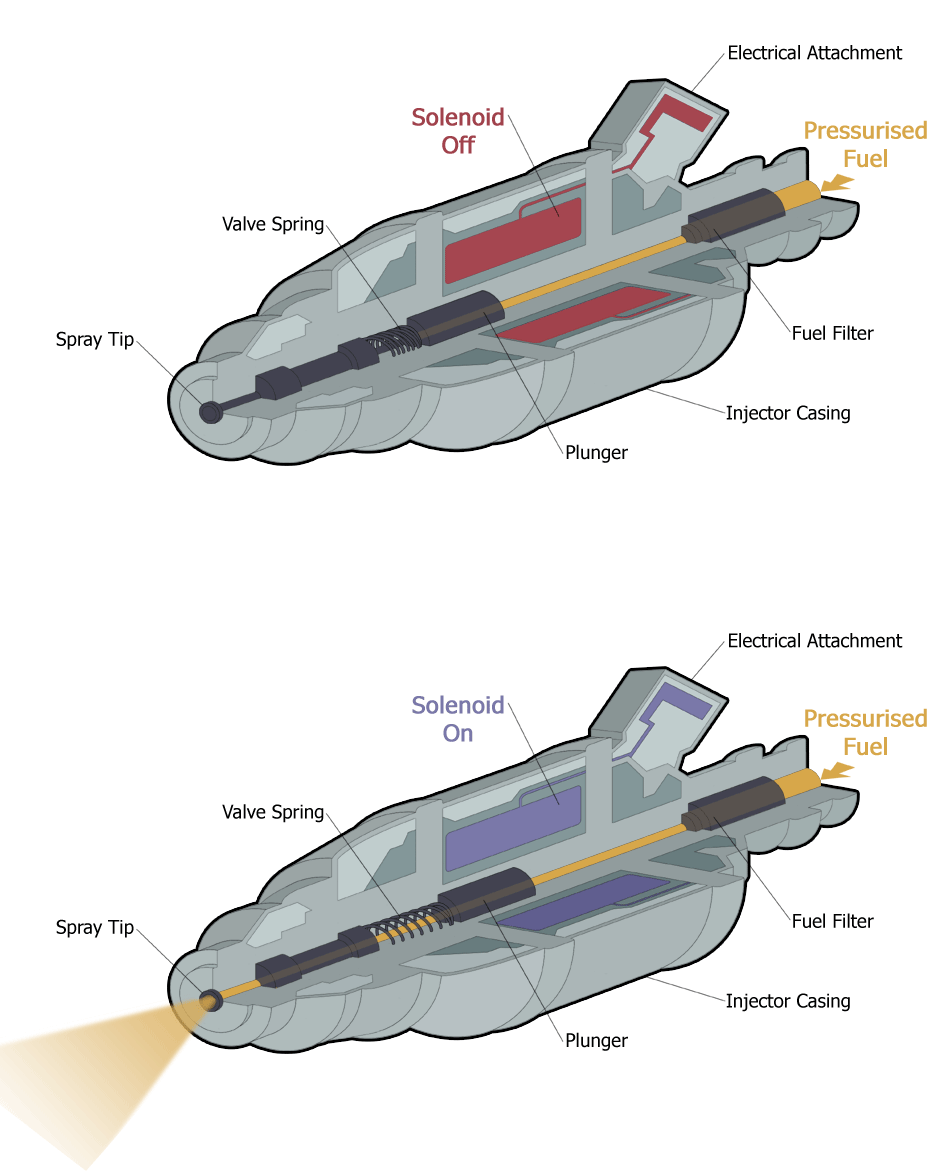
It's just a precision electric valve. That's the whole thing. It opens for a few milliseconds, sprays a measured shot of fuel in a cone-shaped pattern, then slams shut. The engine's ECU controls exactly when it opens and how long it stays open. Thousands of times per minute.
The hard part is the precision. At 6,000 RPM, one injector on a 4-stroke engine fires about 50 times every second. The amount of fuel per pulse changes from a tiny bit at idle to a lot more at full throttle. Get any of that wrong and the engine runs poorly or doesn't run at all.
The Parts Inside
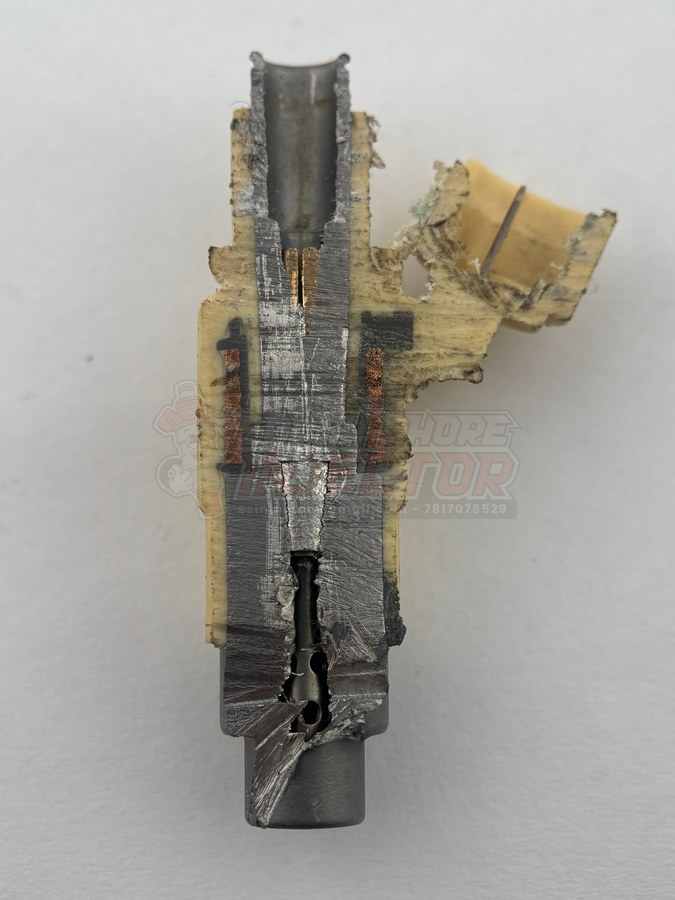
Watch the animation above and you can see most of these working. But here's what one actually looks like cut in half on the bench:
Inlet Filter
A small mesh screen at the top of the injector where fuel comes in from the fuel rail. It catches debris before it reaches the precision parts below. When this clogs up, the injector flows less than it should even if everything else is fine. We replace these on every cleaning when the part is available.
Solenoid Coil
An electromagnet wrapped around the upper body of the injector. When the ECU sends a voltage pulse (usually 12V on most automotive injectors), the coil energizes and creates a magnetic field. That field is what physically lifts the needle off its seat. No coil, no spray. A burned-out coil is a hard failure that cleaning can't fix.
Pintle (Needle)
The actual valve. A precision-machined needle that sits in a matching seat at the bottom of the injector. When the solenoid energizes, the pintle lifts a fraction of a millimeter. When the solenoid de-energizes, a spring slams it back down to seal off the fuel.
This is where most of the trouble happens. The pintle and seat have to mate perfectly to seal off fuel between pulses. Any carbon, varnish, or wear on the pintle tip causes the injector to leak fuel when it shouldn't, or restricts flow when it opens. Even a few thousandths of an inch matters.
Spring
Lives above the pintle. Constantly pushing the pintle down onto its seat. When the solenoid pulls the pintle up, it's working against this spring. When the solenoid releases, the spring is what makes the injector close fast. A weak or broken spring means slow closing and fuel leakage between pulses.
Nozzle and Spray Holes
The bottom tip of the injector with very small holes drilled or laser-cut at specific angles. The number, size, and angle of these holes determines the spray pattern. Some injectors are single-hole pintle types. Modern injectors usually have 4, 6, or 12 small holes that produce a more controlled cone or split-pattern spray.
This is the most damage-prone area. Carbon builds up on the outside of the tip from heat in the intake port. Varnish builds up inside the holes from fuel sitting after shutdown. Both ruin the spray pattern, which means worse atomization, incomplete combustion, and lower efficiency.
O-Rings
Two rubber seals (top and bottom) that seal the injector to the fuel rail and to the intake port. They take a beating from heat and ethanol exposure and eventually crack or compress. Bad o-rings leak fuel at the rail or pull air into the intake. We replace these on every cleaning when the part is available.
The Fire Cycle, Step by Step
Here's what happens during one injection event:
- The ECU calculates how much fuel each cylinder needs based on engine load, RPM, air temperature, throttle position, and a bunch of other inputs.
- That calculation gets converted into a pulse width in milliseconds. At idle this might be 1 to 2 ms. At wide open throttle it might be 15 to 20 ms.
- The ECU sends a 12V pulse through the wire to the injector's solenoid.
- The solenoid energizes. Magnetic field lifts the pintle off its seat against spring pressure. The pintle only moves a fraction of a millimeter, but that's enough.
- Pressurized fuel (40 to 60 psi for port injection, 1,500 to 3,000+ psi for direct injection) sprays through the nozzle holes in a precise pattern.
- The pulse ends. Solenoid de-energizes. Spring slams the pintle shut.
- Repeat 50 times per second per cylinder at high RPM.
Why Injectors Fail
Now that you know what's inside, the failure modes make sense. Here's what we see most often.
Carbon and Varnish Buildup
The most common failure by a wide margin. Heat from the engine bakes carbon onto the outside of the nozzle tip. Fuel sitting in the injector after shutdown leaves varnish deposits inside the spray holes. Over thousands of heat cycles and miles, those deposits get harder.
The result: less fuel sprays through, the spray pattern goes from a fine cone to an uneven stream, atomization gets worse, and combustion suffers. You'll see misfires, rough idle, poor fuel economy, and reduced power. This is what ultrasonic cleaning fixes.
Stuck or Leaking Pintle
If the pintle or seat has been damaged (often from running with bad fuel or after deposits have hardened around it), the injector might not fully close. Fuel dribbles past the pintle when it should be sealed. That fuel ends up in the cylinder at the wrong time, washing oil off the cylinder walls and causing rich misfires.
Sometimes cleaning frees up a stuck pintle. Sometimes the damage is permanent and the injector needs to be replaced.
Burned-Out Solenoid Coil
Electrical failure. The injector simply doesn't fire when the ECU pulses it. You'll see a complete dead-cylinder misfire and a P0201 to P0208 code (injector circuit malfunction).
Cleaning can't fix this. The injector is electrically dead and needs replacement. We test for this on the bench by checking each injector's resistance and pulse response before we even start the cleaning process.
Clogged Inlet Filter
Bad fuel or rust from the inside of an old fuel tank can clog the small mesh filter at the top of the injector. The injector itself is fine, it's just being starved of fuel. Cleaning the injector body usually addresses this since we replace the filter as part of the service.
Cracked O-Rings
Old or ethanol-damaged o-rings can crack, harden, or compress. Symptoms are fuel leaks at the fuel rail (you'll smell gas) or vacuum leaks at the intake port (rough idle, lean misfires). Easy fix as part of a normal cleaning service.
Symptoms Tied to Failure Mode
Once you understand what each part does, you can usually guess which one is going wrong from the symptoms alone.
- Rough idle that smooths out at higher RPM. Usually carbon buildup. At idle, the injector is barely opening, so any restriction has a big impact. At higher RPM, the pulse width is longer and the issue is masked.
- Dead cylinder misfire. Usually electrical (burned solenoid) or a fully clogged injector. Cleaning may or may not help.
- Smell of fuel near the engine bay. Usually a leaking o-ring at the fuel rail or a stuck-open pintle.
- Random multi-cylinder misfires. Often general carbon buildup affecting multiple injectors. Cleaning typically fixes this.
- Poor fuel economy with no other symptoms. Partial flow restriction. The ECU compensates by adding pulse width. You burn more gas to make the same power.
- Won't start when warm but starts cold (or vice versa). Could be a marginal injector right on the edge of working. Worth flow testing.
What Cleaning Fixes vs What It Doesn't
Cleaning fixes:
- Carbon buildup on the nozzle tip
- Varnish deposits inside the spray holes
- Restricted spray patterns
- Mild flow imbalance between injectors
- Clogged inlet filters (we replace these)
- Bad o-rings (we replace these)
Cleaning doesn't fix:
- Burned-out solenoid coils (electrical death)
- Worn or damaged pintle tips that won't seal
- Cracked or warped injector bodies
- Internal corrosion from water-contaminated fuel
That's why we flow test every injector before AND after cleaning. The before test tells us which injectors are saveable. The after test confirms the cleaning actually worked. If an injector isn't responding to cleaning, you find out before it goes back in your engine.
The Bottom Line
Fuel injectors are precision electric valves doing the same thing thousands of times per minute. Most failures come from buildup that ruins the spray pattern or restricts flow, and most of those are fixable with proper cleaning. Some failures (electrical, mechanical wear) aren't fixable and the injector just needs to be replaced.
The only way to know which category your injectors fall into is to test them on a flow bench. A bottle of additive in the gas tank can't tell you. Neither can on-car cleaning. Bench testing each injector individually gives you real flow numbers and spray pattern data that show exactly what's going on.
Key Takeaways
- Fuel injectors are solenoid-operated valves that spray pressurized fuel into the engine
- The pintle, nozzle, solenoid coil, and o-rings are the main parts that wear out
- Failures come from carbon buildup on the pintle, clogged nozzle holes, weak coils, or hardened o-rings
- Ethanol fuel and long sit times accelerate deposit buildup, especially in marine and seasonal use
- Flow testing on a bench is the only way to see whether each injector is in spec
Want to Know What Your Injectors Are Actually Doing?
We clean and flow test fuel injectors for cars, trucks, boats, and powersports starting at $30/injector. Mail us your set, get back a full report on every one.
Get Started