
TBI Fuel Injector Cleaning: What It Looks Like and Why It Matters
TBI (throttle body injection) systems use 1-2 injectors mounted in the throttle body instead of one per cylinder. They're simpler and more reliable than MPFI but still get clogged from carbon deposits, varnish, and fuel-residue buildup. Symptoms include hard starting, rough idle, hesitation, and poor fuel economy. Ultrasonic cleaning + flow testing restores TBI injectors at $35 per injector vs $80-200+ to replace.
From our own bench: on the TBI injectors we flow-test, spread typically drops from around 13% to about 4% after cleaning. TBI injectors are simple and tend to clean up well. Full flow-data study here.
Real TBI injectors we've cleaned and flow-tested, with before/after bench numbers:
- Mercruiser 4.3 / 5.0 / 5.7L TBI (Rochester 17104288-ACR)
- GM 5.7L 350 TBI, high-flow (Rochester 5235206)
Already know it's the TBI injectors? You can send them in here.
Throttle body injection (TBI) systems are some of the most reliable fuel systems ever put into production vehicles. GM used them for years across their truck and car lineup, and a lot of those engines are still running strong decades later. But "reliable" doesn't mean "maintenance-free," and the injectors in a TBI unit are no exception.
We recently had a set of TBI injectors come through the shop, and the photos tell the story better than anything. Here's a look at what we found, how we cleaned them, and what you should know if you're running a TBI-equipped vehicle.
What Is Throttle Body Injection?
Before multi-port fuel injection became the standard, most fuel-injected vehicles used throttle body injection. Instead of having one injector per cylinder mounted on the intake manifold, TBI uses one or two injectors mounted directly in the throttle body, right where the carburetor used to sit. It was a huge step up from carburetors in terms of reliability and fuel efficiency, and it was a lot simpler than the multi-port systems that came later.
You'll find TBI systems on a ton of GM vehicles from the mid-1980s through the mid-1990s. The 305 and 350 small blocks in trucks and SUVs ran TBI for years, and so did the 4.3L V6. Plenty of other manufacturers used similar setups during that era too.
The injectors themselves look different from the port-style injectors most people are used to seeing. They're shorter and wider, almost cylindrical, and they sit right on top of the throttle body where they spray fuel down into the intake. Because they're exposed to incoming air and sitting right above a hot engine, they tend to accumulate deposits in a different way than port injectors do.
What We Found: Before Cleaning
When these injectors showed up, you could see the buildup right away. The outside of both injectors had a layer of baked-on grime and carbon that had been building up over years of use. This is pretty normal for TBI injectors because they sit in the throttle body exposed to heat, blowby gases, and whatever comes through the air filter.
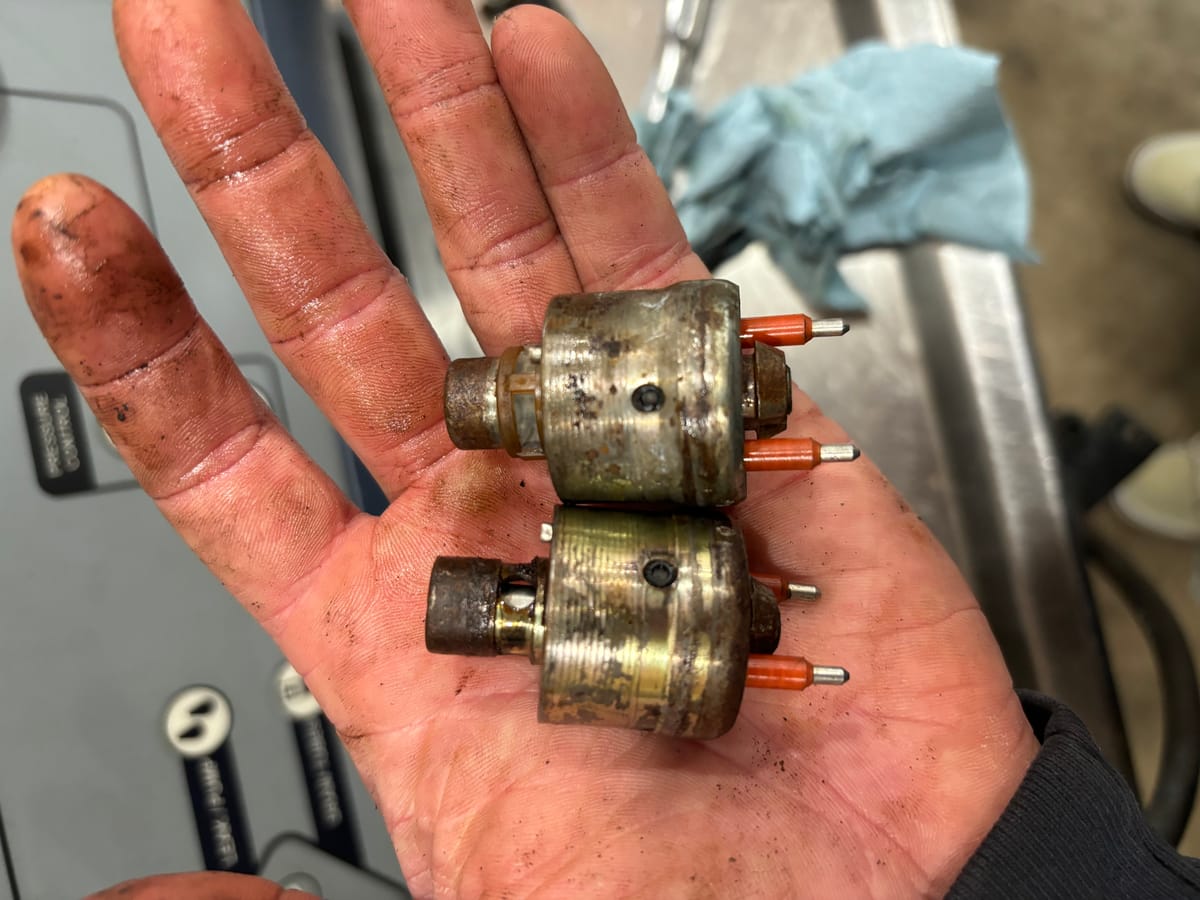
The external crud is ugly, but it's the stuff you can't see that really causes problems. Inside the injector, deposits form around the pintle and the nozzle opening. That's where fuel is supposed to atomize into a fine mist for combustion. When deposits narrow that opening or change the shape of the spray pattern, the engine doesn't get the fuel delivery it needs. You end up with rough idle, poor throttle response, bad fuel economy, and sometimes hard starting.
TBI injectors are especially prone to this because they spray fuel into the airstream above the throttle plates. Heat from the engine rises up through the throttle body and bakes deposits onto the injector tips over time. Every time you shut the engine off, the residual fuel on the injector tip gets cooked by the heat soak. Do that a few thousand times and you've got a problem.
The Cleaning and Testing Process
The whole process starts with disassembly. The throttle body, gaskets, injectors, and associated hardware all come apart so every piece can be cleaned and inspected individually. This is also when we check the condition of the o-rings and gaskets. Old TBI o-rings get hard and brittle, which causes vacuum leaks and fuel seepage. If the o-rings are cracked or flattened, they need to go. A cleaned injector with a bad o-ring is still going to give you problems.
From there, the injectors go through our ultrasonic cleaning process. This isn't the same as spraying them with carb cleaner or running a bottle of fuel system cleaner through the tank. Ultrasonic cleaning uses high-frequency sound waves in a specialized solution to physically break apart carbon deposits at a microscopic level. It gets into places that no spray or solvent can reach on its own.
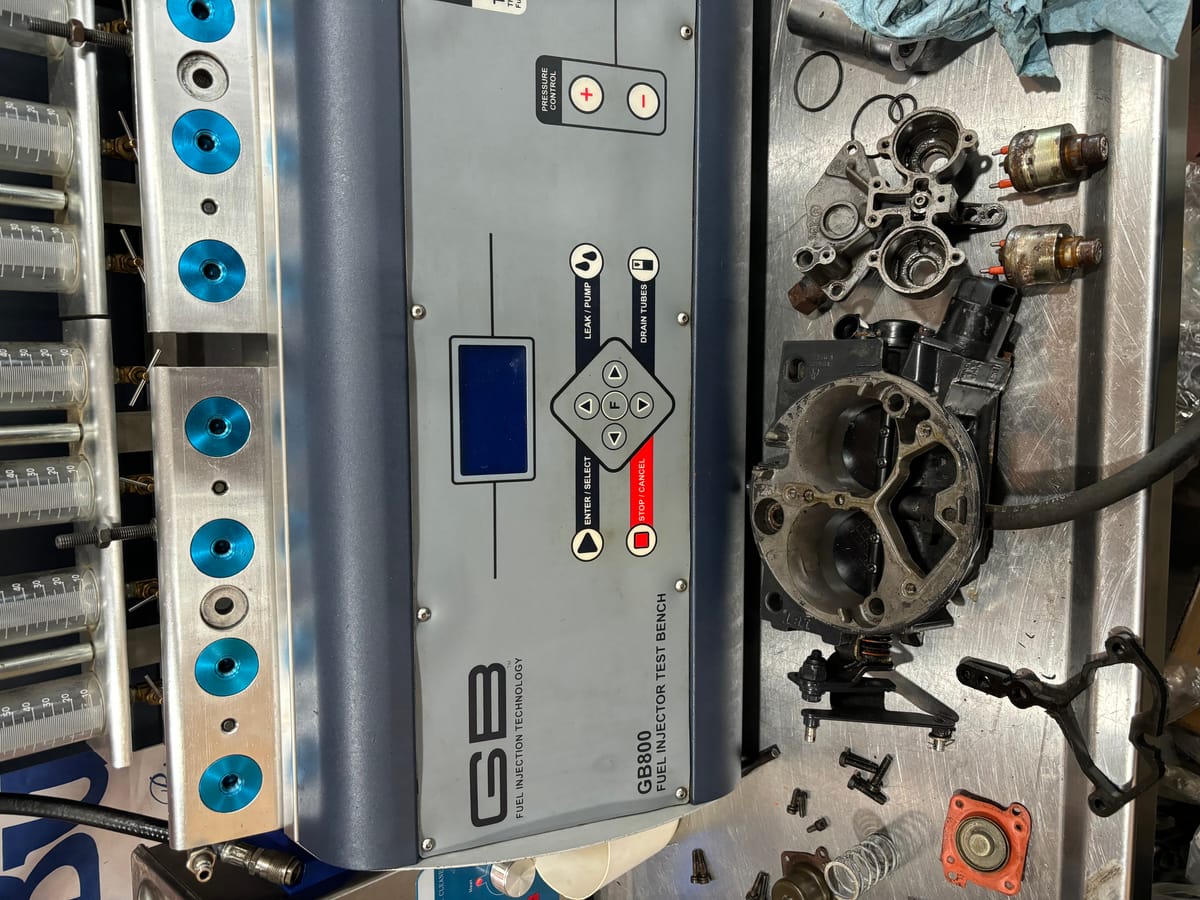
After cleaning, each injector goes on the flow bench. We test them individually to measure the actual fuel flow at different pulse widths and pressures. This tells us whether the injectors are flowing within spec and, more importantly, whether they're flowing the same as each other. On a TBI system with two injectors, matched flow is critical. If one injector is flowing 15% more than the other, you'll have an uneven fuel distribution that the ECU can't fully compensate for.
We also check the spray pattern on the bench. A healthy TBI injector should produce a consistent, cone-shaped spray. Deposits can cause the spray to go off-center, stream instead of mist, or come out in an uneven pattern. All of that leads to poor combustion and wasted fuel.
After Cleaning: The Results
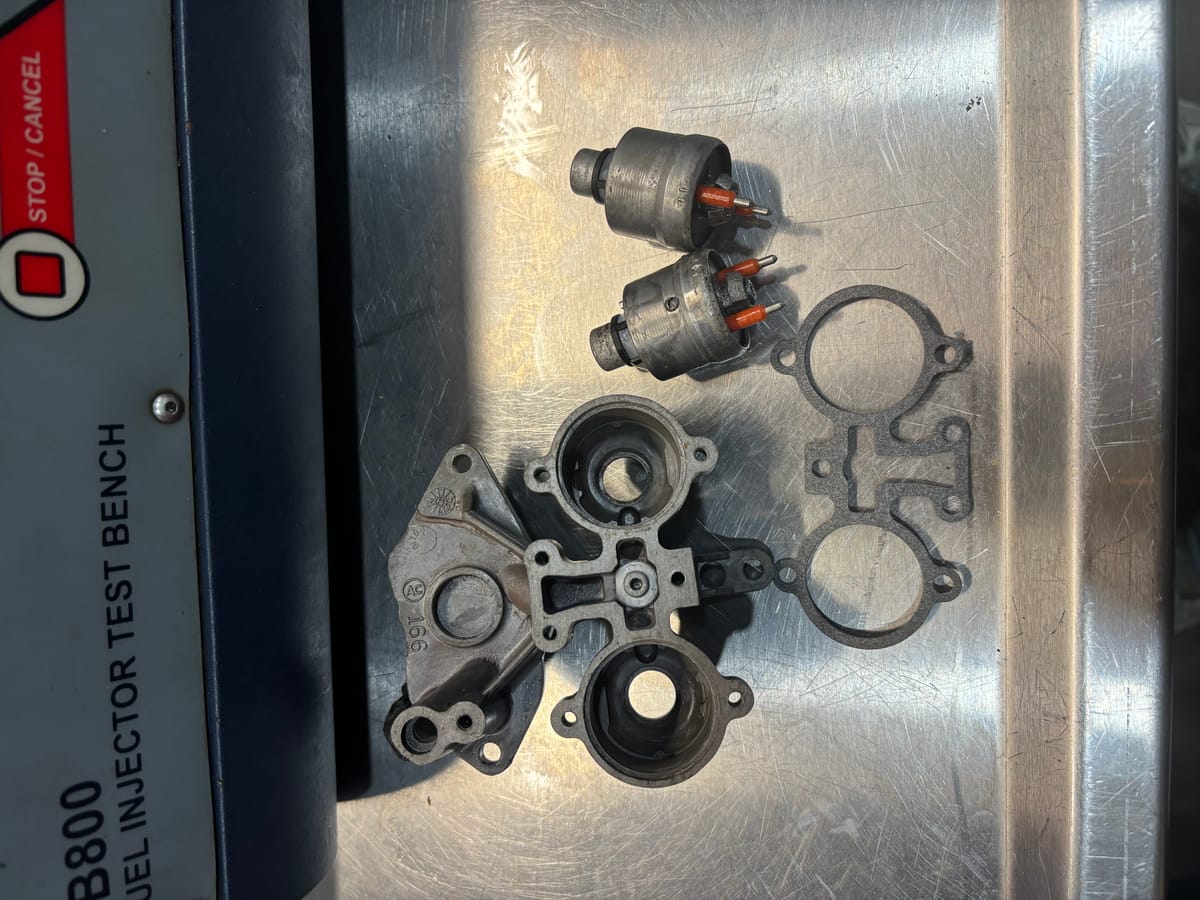
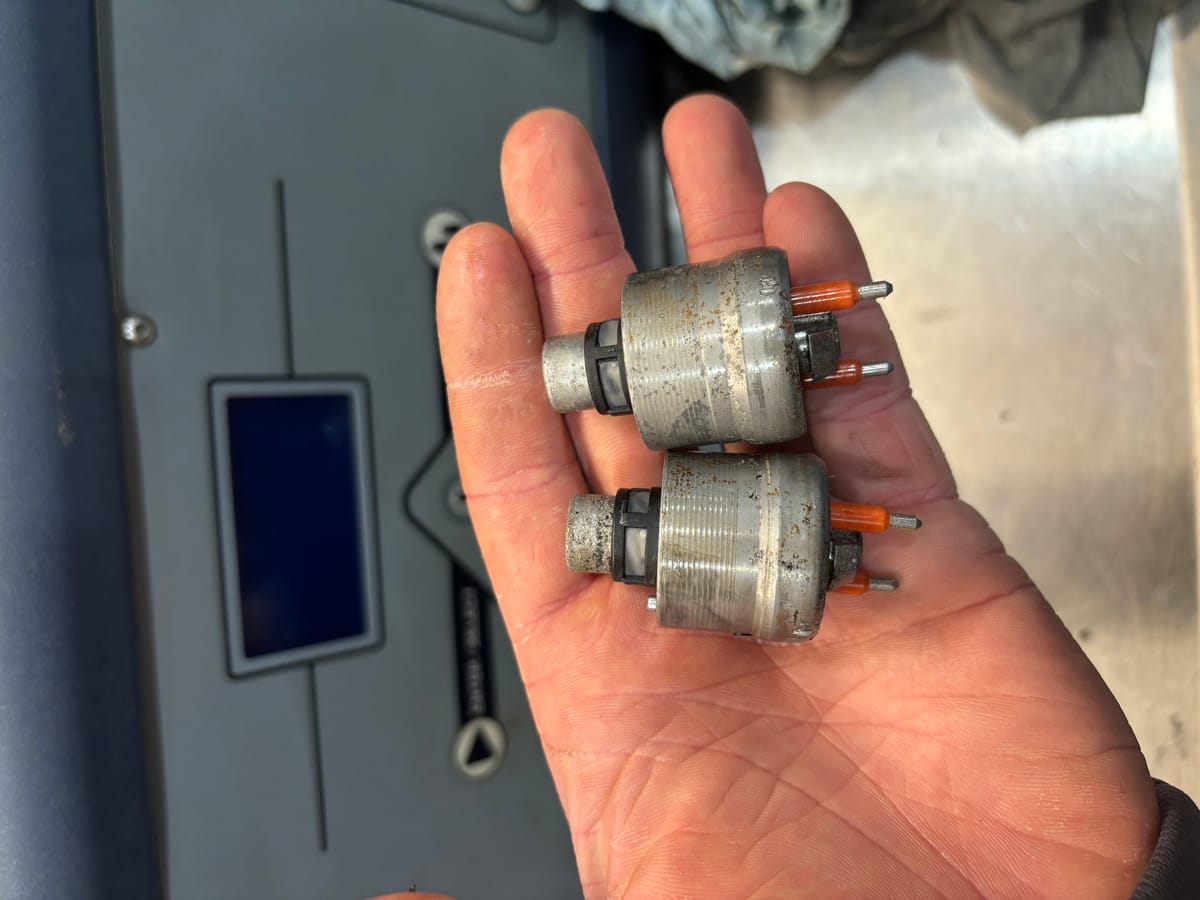
The before and after difference is clear just from looking at the outside. But the numbers on the flow bench are what actually matter. Before cleaning, injector #2 was failing the leak-down test -- it was dripping fuel when it should have been sealed shut. A leaking injector means fuel is seeping into the intake even when the ECU isn't commanding it to fire. That causes hard starting (especially hot starts), fuel smell, and wasted gas. After ultrasonic cleaning, both injectors passed the leak-down test, and flow rates were within 1-2% of each other, which is exactly where you want them. The spray patterns were clean and consistent.
That kind of result means the engine will idle smoother, respond better to throttle input, run more efficiently, and produce cleaner emissions. For a truck or SUV that's been running rough and burning more gas than it should, a proper injector cleaning can feel like a whole different vehicle.
Common Vehicles with TBI Systems
If you're not sure whether your vehicle has throttle body injection, here's a quick reference. GM was the biggest user of TBI, but other manufacturers had their own versions too.
GM / Chevrolet / GMC
- 1987-1995 Chevy K1500, K2500, K3500 (5.7L 350 TBI)
- 1988-1995 GMC Sierra (5.0L 305 TBI and 5.7L 350 TBI)
- 1988-1995 Chevy C1500, C2500, C3500 (5.0L and 5.7L TBI)
- 1992-1995 Chevy Blazer, GMC Jimmy (4.3L V6 TBI)
- 1988-1995 Chevy Suburban (5.7L TBI)
- 1985-1992 Chevy Camaro, Pontiac Firebird (5.0L and 5.7L TBI)
- 1987-1993 Chevy G-series vans (5.7L TBI)
- 1985-1993 Chevy S-10, GMC S-15 (2.5L 4-cyl TBI and 4.3L V6 TBI)
Other Manufacturers
- 1986-1991 Jeep Cherokee, Wrangler (4.0L and 2.5L Renix TBI)
- 1988-1993 Dodge trucks (5.2L 318 and 5.9L 360 TBI)
- Various Ford trucks with CFI (Central Fuel Injection) -- Ford's version of TBI
If your truck, SUV, or car was made between roughly 1985 and 1995 and has fuel injection but only one or two injectors visible in the throttle body, it's a TBI system. Later vehicles switched to multi-port injection with one injector per cylinder mounted on the intake manifold.
How Often Should TBI Injectors Be Cleaned?
There's no universal interval because it depends on a lot of factors. The type of fuel you run, how often you drive the vehicle, whether it sits for extended periods, and the overall condition of the fuel system all play a role.
That said, here are some general guidelines:
- If the vehicle is a daily driver running regular pump gas, every 50,000 to 75,000 miles is a reasonable interval for preventive maintenance.
- If the vehicle sits for weeks or months at a time (seasonal trucks, show cars, project vehicles), the injectors will accumulate deposits faster because fuel breaks down and varnishes while sitting.
- If you're running E10 or higher ethanol blends, the deposits tend to form quicker because ethanol attracts moisture and leaves behind different residues than straight gasoline.
- If you're noticing any symptoms like rough idle, hesitation, poor fuel economy, or hard starting, don't wait for a mileage interval. Get them tested.
A lot of the TBI vehicles still on the road have injectors that have never been cleaned. These engines were built in the late '80s and early '90s, so we're talking 30+ years of deposits in some cases. If the truck still runs, the injectors are probably still somewhat functional, but they're almost certainly not performing anywhere near where they should be. Even if you're not having obvious symptoms, a cleaning and flow test can reveal issues you've been living with without realizing it.
Can You Clean TBI Injectors Yourself?
You can pull the injectors out of the throttle body with basic hand tools — our removal guide walks through the process. That part is straightforward. The problem is that without an ultrasonic cleaner and a flow bench, you're limited to soaking them in solvent and hoping for the best. That might help a little with light surface deposits, but it won't touch the hardened carbon inside the injector body or give you any data on whether the injectors are actually flowing correctly.
The other thing you lose without a flow bench is the ability to match the injectors. You could clean both injectors and have them look great on the outside, but if one is flowing 20% more than the other, you still have a problem that you can't diagnose without testing equipment.
Why Not Just Replace Them?
You can, and sometimes that's the right call. But new TBI injectors aren't always easy to source for every application, and the aftermarket replacements can be hit or miss in terms of quality. We've seen brand-new injectors come out of the box with worse flow numbers than cleaned originals.
The other advantage of cleaning and testing the originals is that you know exactly what you're getting. The flow data shows you the real performance of each injector after cleaning. With a new injector off the shelf, you're trusting that it meets spec without actually verifying it.
For most people, professional cleaning is the better option. At $30 per injector, it costs less than replacement, you keep the OEM parts, and you get actual performance data to back it up. If an injector is truly dead and won't respond to cleaning, we'll tell you. But more often than not, a thorough cleaning brings them right back to where they need to be.
Mail-In TBI Injector Cleaning
You don't need to be local to get your injectors serviced. We offer nationwide mail-in cleaning for all types of fuel injectors, including TBI. Just pull your injectors, box them up, and ship them to us. We'll clean them, flow test them, and send them back with a full report showing the before and after numbers.
The whole process usually takes 1-2 business days from when we receive them, plus shipping time both ways. Round-trip USPS Ground Advantage shipping is included with the service. Optional insurance is available at checkout for higher-value sets.
TBI units ship easily because they are small. See how mail-in service works if there is no injector shop near you.
Key Takeaways
- TBI uses 1-2 injectors mounted in the throttle body, not per-cylinder like MPFI
- GM trucks (1987-1995), Chevy/GMC pickups, S10s, Suburbans, and many cars used TBI
- Common symptoms: hard starting, rough idle, hesitation, fuel smell, poor mileage
- TBI injectors are $35 each to clean vs $80-200+ to replace with OEM
- Ultrasonic cleaning + flow testing restores TBI injectors to factory spec in most cases
- Turnaround is 1-2 business days from receipt, plus round-trip shipping time
Ready to Get Your TBI Injectors Cleaned?
Professional ultrasonic cleaning and flow testing starting at $30/injector with prepaid round-trip USPS shipping.
Get Started