
Fuel Injector Cleaning vs Replacement
Clean first. Most injectors that cause running problems are dirty, not failed, and they come back to spec on a flow bench. Replacement is for real physical faults: a dead coil, a worn pintle, corrosion, or a cracked body. You can't tell which you have by looking, so the smart order is test, clean what's recoverable, and replace only the few that actually fail. Cleaning runs $30-35 per injector. New injectors are $80 to $300+ each.
Somewhere between "my engine runs rough" and "I need new injectors" there's a step most people skip. Injectors are one of the few engine parts you can almost always fix instead of replace, and the price gap between the two is huge. But cleaning isn't magic, and there are cases where you really do need new ones. Here's how to tell them apart.
What Cleaning Actually Fixes
The vast majority of injector problems are deposits, not failure. Over years of heat cycles, carbon and varnish build up on the pintle and inside the nozzle, ethanol fuel leaves gum behind, and the spray pattern degrades. The injector still works, it just doesn't flow evenly or atomize the way it should. Cleaning targets all of that:
- Clogged or partially blocked nozzles
- Carbon and varnish on the pintle and seat
- Weak, dribbling, or off-center spray patterns
- Uneven flow across a set (one lazy injector makes the whole engine run rough)
- A sticky pintle that's slow to open or close
- Minor leak-down from deposits holding the seat open
Ultrasonic cleaning and backflushing clear that buildup, and a good spray pattern and even flow come back. Our four-year flow bench study lays out how often injectors show up out of spec and how much cleaning recovers.
What Cleaning Can't Fix
Cleaning is a deposit problem-solver. It does nothing for a part that's mechanically or electrically broken:
- Dead coil - an open or shorted solenoid winding. If the coil won't fire, no amount of cleaning brings it back.
- Mechanical wear - a pintle or seat that's worn or scored won't seal or meter correctly anymore.
- Internal corrosion - water-contaminated fuel can pit and corrode the internals past the point of cleaning.
- Physical damage - a cracked body, stripped connector, or damaged threads.
These are the cases where replacement is the honest answer. The good news is they're the minority.
You Can't Tell By Looking
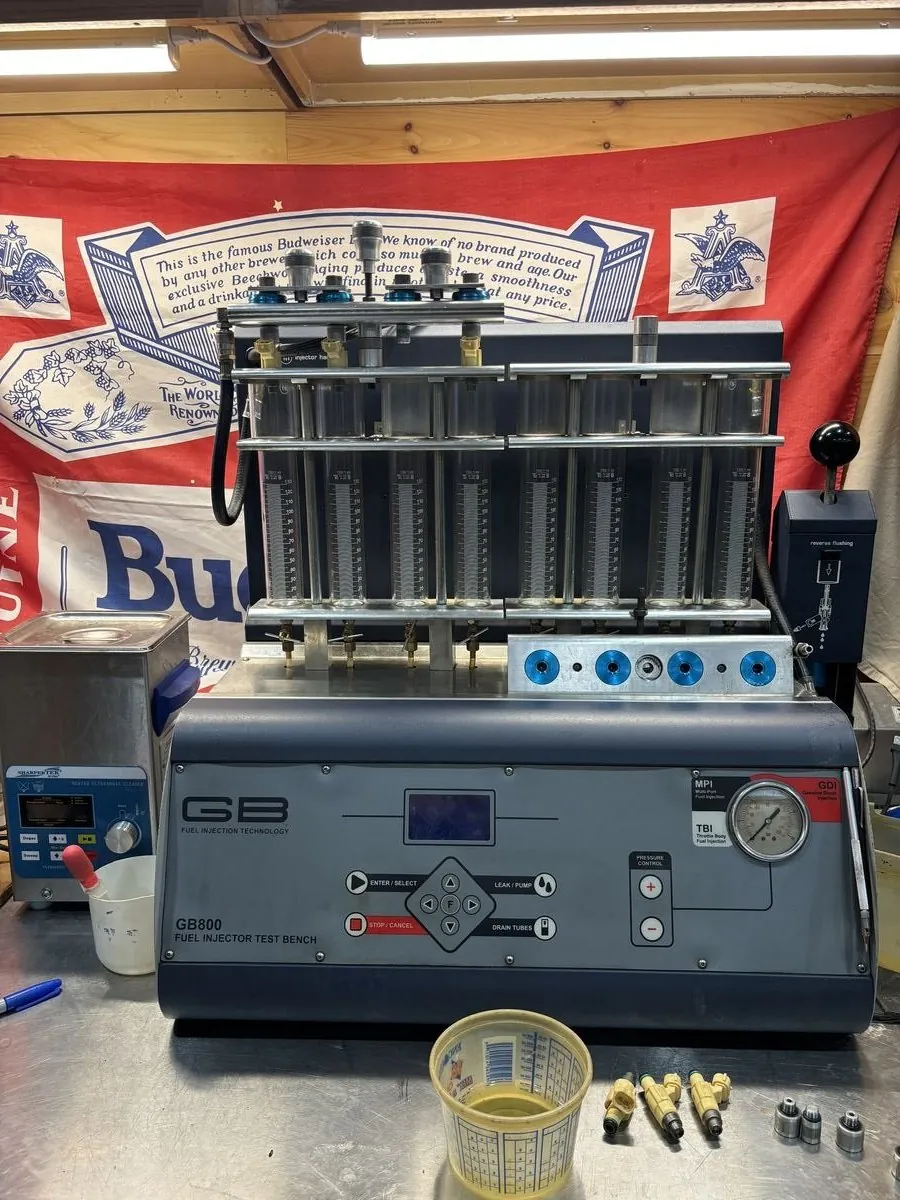
Here's the core problem: a dirty injector and a dead injector can look identical sitting on the bench, and both throw the same symptoms in the car or boat, rough idle, misfires, poor economy, hard starting. A bottle of cleaner in the tank won't tell you which you've got, and neither will a mechanic swapping parts by feel. The only thing that actually answers the question is a flow bench that tests each injector before and after: how it flows, how it sprays, whether it holds, and what the coil reads. That's how you separate the dirty from the done.
Real Recovery Numbers Off Our Bench
This isn't theoretical. A few examples from injectors we've actually serviced, all documented in our recently serviced database:
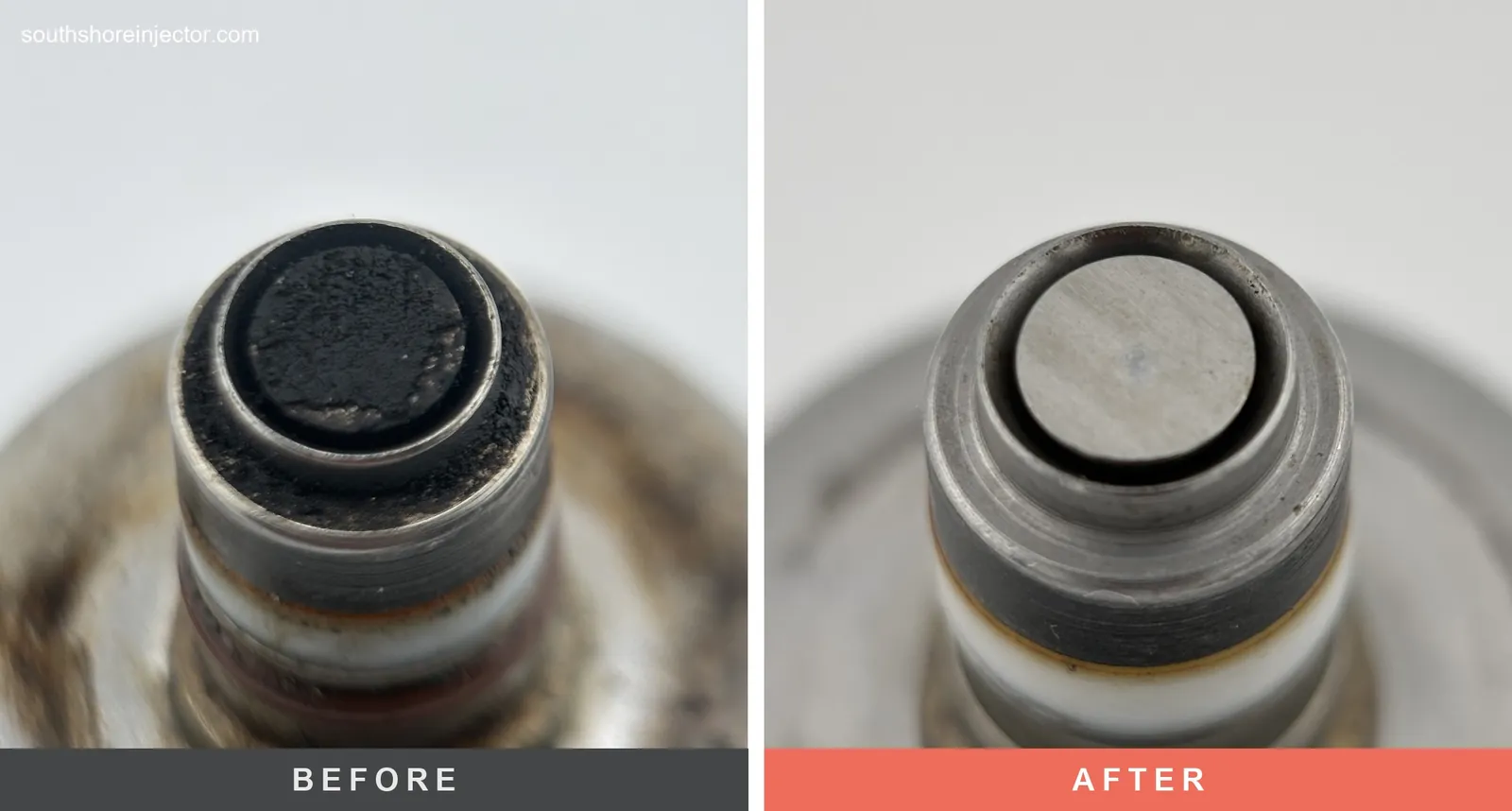
- A set of Yamaha F90 injectors came in flowing 14.75 ml and left at 32 ml, more than double, back to healthy spec from badly clogged.
- A set of Mercruiser 7.4L 454 injectors went from 26.71 ml to 46.5 ml, with leak-test pass rate climbing as the deposits cleared.
- A set of Sea-Doo 4-TEC injectors recovered from 33 ml to 57 ml.
Those were all headed for the trash in a lot of people's minds. New sets would have run hundreds of dollars. Cleaning brought them back, and the customer got a report proving it.
The Cost Math
This is where the decision usually makes itself. Cleaning is $30 per injector for standard MPFI top-feed and $35 for everything else, plus $15 flat round-trip shipping. A set of six is roughly $195-225 all in.
New injectors, depending on the application, run $80 to $300+ each. Marine, GDI, and performance injectors sit at the top of that range. That same set of six replaced new is anywhere from $500 to $1,800. If cleaning has a good shot at bringing them back, and for dirty injectors it does, spending six to ten times more to replace them first is money thrown away.
The Cheap Injector Trap
When people do decide to replace, a lot of them reach for the $40 set of eight on eBay or Amazon. We see how that story ends. A big share of those are aftermarket knockoffs, not genuine Bosch, Delphi, Denso, or Siemens, and they fail early or show up dead in the box. You install the set, one won't flow right or one leaks, and now you're pulling the rail a second time and buying again. Do that twice and you've spent more than a genuine set or a cleaning job would have cost, plus the weekends. Cheap replacement isn't cheap when half the set doesn't last a season.
So if you're replacing, buy genuine and get it flow tested before it goes in. And if the injectors you already have are just dirty, cleaning a known-good genuine injector beats gambling on a no-name replacement every time. You keep the part the manufacturer built for your engine and you get data proving it works.
When Replacement Is the Right Call
To be straight about it, replace instead of clean when:
- Testing shows an open or shorted coil
- The pintle or seat is visibly worn or won't hold after cleaning
- There's internal corrosion from water in the fuel
- The body is cracked or the injector is physically damaged
- The injector is genuinely obsolete and you're upgrading the whole set on purpose
Even then, you usually only replace the one or two that failed, not the whole set.
The Approach That Actually Saves Money
You don't have to choose blind between "clean everything" and "replace everything." The right move is to test the set, clean the ones that are recoverable, and replace only the few that fail. That's how we run every job: pre-test, clean, flow test again, and a report that tells you exactly which injectors came back and which ones didn't. Nobody gets a dead injector back with a "cleaned" sticker on it.
The OptiMax air injector is a perfect example of this in action, injectors people are quoted hundreds to replace that turn out to be stuck, not dead, and come right back with cleaning.
Key Takeaways
- Most "bad" injectors are just dirty and come back to spec with cleaning
- Cleaning fixes deposits, clogs, weak spray, and uneven flow; it can't fix a dead coil, worn pintle, corrosion, or a cracked body
- You can't tell dirty from dead by looking, only a before-and-after flow test can
- Real sets have recovered from half-flow to full flow on our bench
- Cleaning is $30-35 per injector; new injectors are $80-300+ each
- Cheap eBay/Amazon knockoff injectors often fail early or arrive dead, so if you replace, buy genuine and flow test it
- Best approach: test the set, clean what's recoverable, replace only what fails
Not Sure If Yours Are Dirty or Done?
Send them in. We flow test every injector before and after and tell you exactly which ones came back. $30-35/injector with prepaid round-trip shipping.
Get Started